Katy for Kansas
June 24, 2026 · Newsletter
Four Years After Dobbs, Grandpa Might Have Had Something To Say
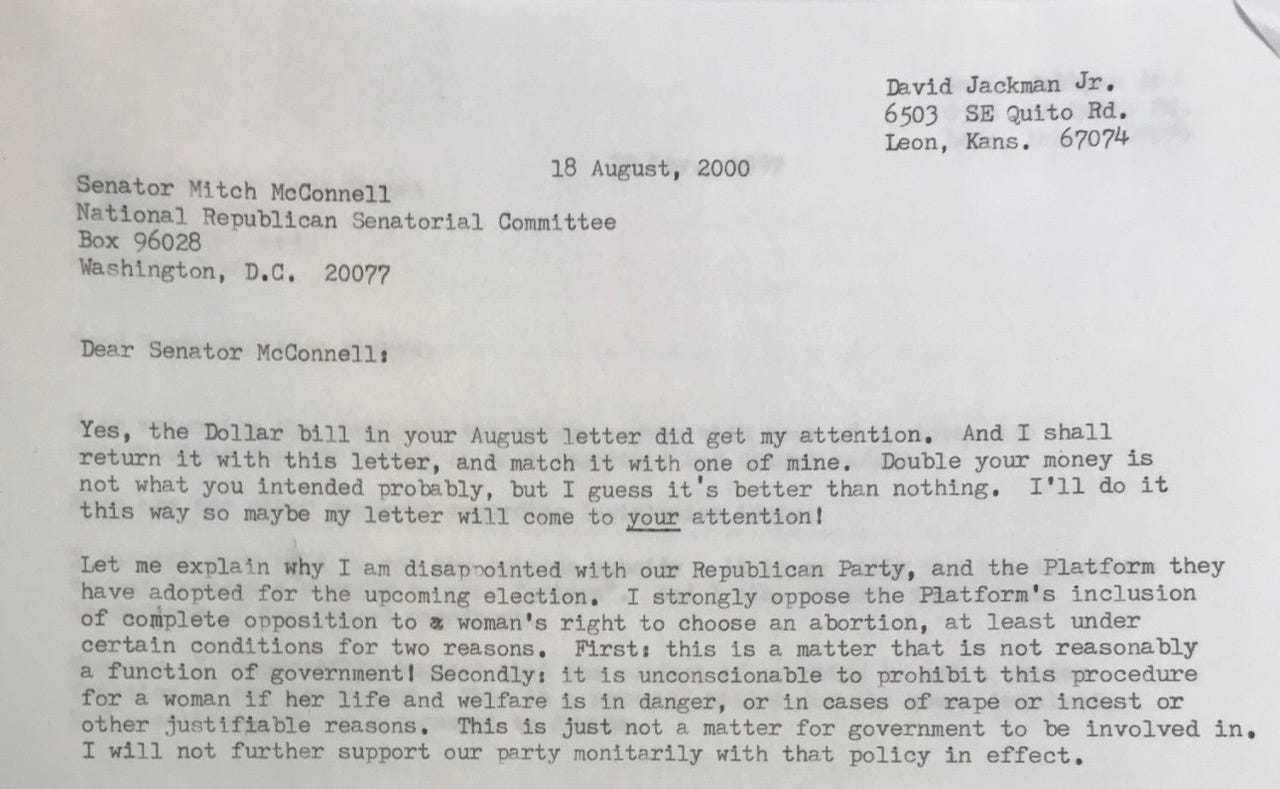
Those were the opening words of a letter my grandfather wrote to Republican Party leaders on August 18, 2000. My grandfather grew up in Wichita and spent the last forty years of his life in Leon. He was a lifelong Republican who believed in personal responsibility, fiscal discipline, and individual freedom. He wasn’t quite as—shall we say—malleable as some in the Republican Party today. No, Grandpa Jackman's political views didn’t change with the wind, and he drew a line when it came to reproductive freedom.
In that same letter, he wrote: “I strongly oppose the Platform’s inclusion of complete opposition to a woman’s right to choose an abortion, at least under certain conditions for two reasons. First: this is a matter that is not reasonably a function of government! Secondly: it is unconscionable to prohibit this procedure for a woman if her life and welfare is in danger, or in cases of rape or incest or other justifiable reasons. This is just not a matter for government to be involved in. I will not further support our party monetarily with that policy in effect.”
Twenty-six years later, those words feel remarkably relevant. Today marks four years since the Supreme Court handed down its decision in Dobbs v. Jackson Women’s Health Organization, which overturned nearly fifty years of constitutional protection for abortion rights in America.
For millions of women across this country, Dobbs sent a clear message: women cannot be trusted to make their own healthcare decisions. With the stroke of a pen, the Supreme Court gave license to politicians to insert themselves into deeply personal healthcare decisions and for the government to substitute its judgment for that of a patient and her doctor.
As the mother of two daughters, the weight of that decision wears on me. My girls are growing up with fewer freedoms than I had when I was their age. Thankfully, we live in Kansas, where for now, a woman’s right to choose is still protected, but a women’s bodily autonomy shouldn’t depend on her zip code.
In 2022, when Kansas politicians attempted to remove reproductive rights protections from our state constitution, Kansans rejected that effort and mirrored my grandfather’s words with their vote. Republicans, Democrats, independents, and unaffiliated voters came together to say that healthcare decisions should remain personal decisions.
That vote wasn’t just about abortion. It was about freedom. It was about whether politicians should have the power to make intimate medical decisions for families they have never met. It was about whether government should know its limits.
My grandfather understood that principle more than a quarter-century ago. He didn’t view reproductive healthcare through a partisan lens. He viewed it through the lens of individual liberty and limited government. And frankly, I think there is wisdom in that approach.
Reasonable people can have deeply held beliefs about abortion. They can wrestle with difficult moral questions and arrive at different personal conclusions. But the most critical question at the end of the day is: who should make these decisions?
Unless it’s a matter of public health, I believe healthcare decisions should be left to patients and their medical providers. I believe women deserve the freedom to make their own choices. And I believe government should be extraordinarily cautious before inserting itself into the most personal aspects of people’s lives.